
Carved Square Antique Chinese Table
Quantity
Short Description
In a contemporary Bangkok residence, a carefully selected antique like this can provide exactly the element that a highly controlled interior sometimes lacks: individuality. It introduces warmth and visual history without requiring the entire room to become traditionally styled.
Dimension: Width 97 x Depth 97 x Height 56 cm.
Price: 45,000 Baht
Some furniture makes an impression through decoration. Others become memorable because of the character contained within their material, structure and details. This Carved Antique Chinese Table belongs to the latter.
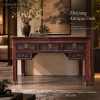
The first impression comes from its aged wooden surface. Rather than appearing perfectly uniform, the timber carries natural variation across its colour and texture, giving the table a visual depth that becomes more apparent as it is viewed closely. This quality is particularly effective in contemporary interiors, where restrained materials and clean surfaces create an ideal setting for something with more irregularity and character.
The structure adds another layer of interest. Along the apron are carved decorative details, while the open framework beneath the tabletop introduces a rhythm of solid and negative space. Curved supporting elements give the structure a sense of movement, while the central carved motif provides a visual focal point. These details make the table interesting not only from above, but from the perspective of someone sitting across from it.
Its strongest role within an interior is therefore not simply as a functional table, but as an element that changes the character of the surrounding space.
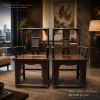
Placed among contemporary furniture, the contrast becomes especially compelling. A restrained sofa, natural stone, neutral textiles and modern architectural lines provide a quiet backdrop for the antique wood. The table does not need the rest of the room to imitate its traditional character. Instead, its presence introduces another layer of time, texture and craftsmanship.
This approach can work particularly well in sophisticated residences where the interior is built around a mixture of materials and periods. Rather than creating a room where every object belongs to the same visual language, an antique can act as the point of difference. It gives the eye somewhere to pause and creates the feeling that the interior has been curated over time.
The carved details also reward closer attention. From a distance, the table reads as a substantial wooden form. As one moves closer, the carved apron, openwork construction and central decorative motif become increasingly apparent. That change in perception is part of its appeal: the furniture can contribute to the room from a distance while offering greater visual interest when experienced up close.
For a homeowner or collector, this is the kind of piece that can help define an interior without overwhelming it. Its character comes from what can be seen in the furniture itself—the surface of the timber, the carved structure, the contrast between solid and open elements, and the distinctive visual language of the piece.
In a contemporary Bangkok residence, a carefully selected antique like this can provide exactly the element that a highly controlled interior sometimes lacks: individuality. It introduces warmth and visual history without requiring the entire room to become traditionally styled.
The result is a more layered way of living with Chinese antique furniture—one where the antique is appreciated not simply because it is different from contemporary furniture, but because its character gives the contemporary interior something it could not achieve on its own.


 MakeWebEasy