Restoring the Character of a Chinese Antique Cabinet
Restoration Begins with Understanding the Cabinet
Before any restoration begins, the cabinet needs to be understood as an object rather than simply as furniture that requires repair.
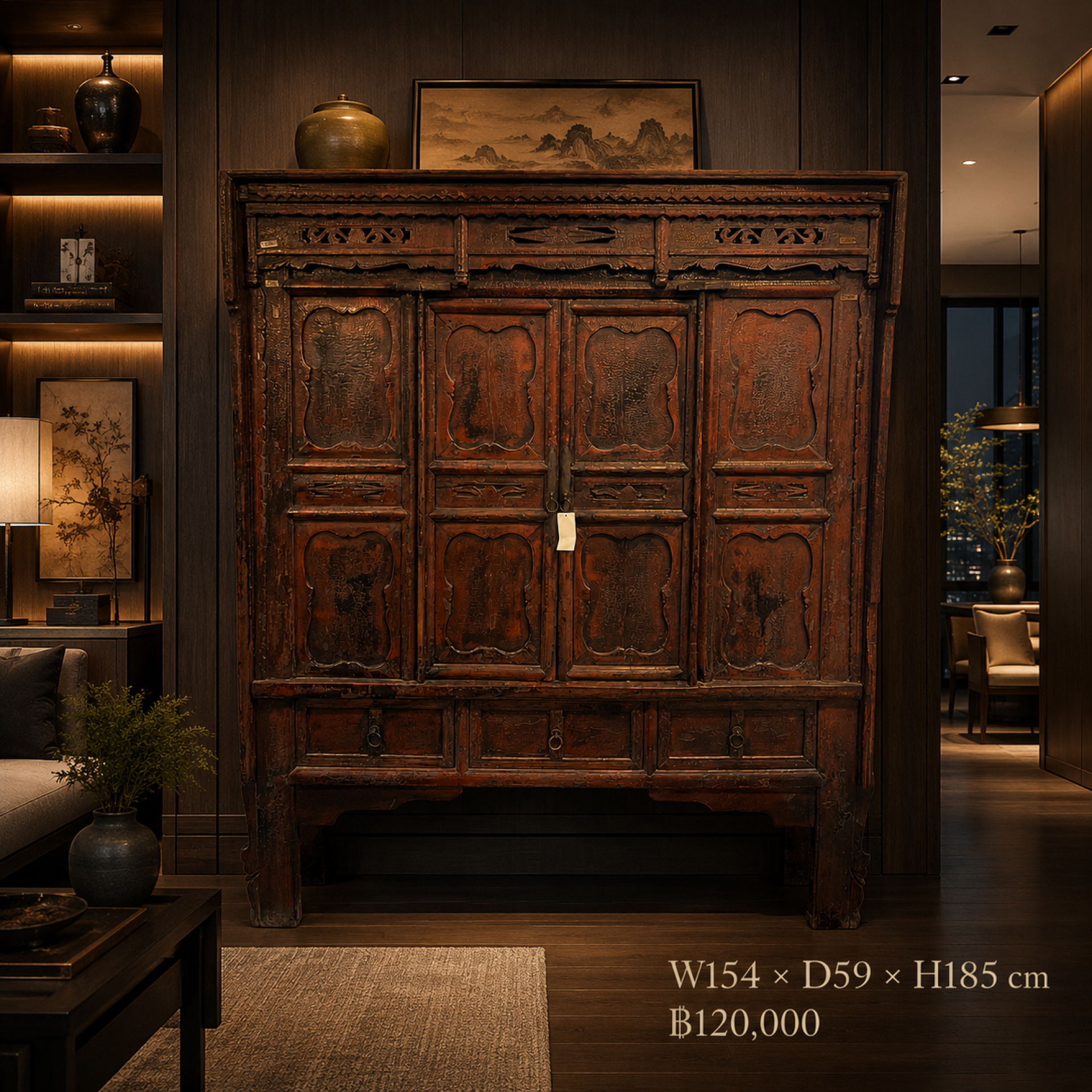
An experienced assessment looks at the relationship between its structure, surface, hardware, proportions and overall condition. A loose joint is different from an aged surface. A damaged fitting requires a different response from a naturally uneven finish. A mark from use may tell part of the cabinet's visual story without being a defect that needs to disappear.
This distinction is particularly important with Chinese antique furniture. Age and use can produce changes in colour, texture and surface that contribute to the character of a piece. Removing every irregularity may produce a cleaner appearance, but it can also remove some of the qualities that make the cabinet visually distinctive.
The first question, therefore, is not simply, "How can this cabinet be made beautiful again?"
It is, "What should be preserved?"
What Time Leaves Behind
Surface, Patina and Wear
The surface is often the first thing people notice about an antique cabinet.
Colour may vary across panels. Edges may show more wear than protected areas. The finish may have developed subtle differences over time. Small marks can appear around handles, doors and frequently touched surfaces.
These details should not automatically be treated as imperfections.
For an antique cabinet, character can come from precisely this variation. A restrained restoration allows the surface to retain its visual depth rather than reducing everything to a uniformly polished finish.
Cleaning therefore deserves particular care. The objective should be to understand what is present before deciding what should be removed, retained or repaired.
Structure and Movement
The structure deserves equal attention.
Traditional wooden furniture is affected by changes in its environment. Timber can respond to humidity and temperature, and components may move over time. Joints can loosen, panels can shift and doors can become difficult to operate.
These conditions do not necessarily mean that a cabinet has been poorly made or that it has failed.
They are part of the practical considerations involved in caring for furniture made from natural materials.
A thoughtful restoration begins by identifying which issues affect stability and function and which simply belong to the cabinet's existing appearance.
Repairing Without Erasing Character
Structural Stabilisation Comes First
When an antique cabinet requires repair, structural stability is usually the most practical starting point.
Joints, doors, panels, feet and hardware should be examined according to their actual condition. Repairs should address the problem without unnecessarily disturbing areas that remain sound.
This is where restoration differs from refurbishment.
Refurbishment can pursue a particular visual result. Restoration requires greater restraint because the existing object carries information in its materials, construction and surface.
The aim is not to make every component appear identical. It is to return the cabinet to a condition in which it can be understood, used and appreciated without unnecessarily sacrificing what has survived.
Surface Restoration Requires Restraint
Surface treatment can be one of the most sensitive parts of restoring Chinese antique furniture.
A cabinet may have an existing finish whose appearance has changed over time. Aggressive cleaning, excessive polishing or indiscriminate refinishing can alter that appearance permanently.
For this reason, restoration should begin with examination and careful consideration rather than a predetermined treatment.
The most appropriate approach depends on the cabinet itself: its construction, existing finish, condition and intended use. Where the surface contributes strongly to the character of the piece, preserving rather than replacing becomes especially important.
The Art of Selective Restoration
Not every damaged element needs to be completely remade.
A missing fitting may require replacement. A loose joint may need stabilisation. A damaged structural component may need careful repair. In other situations, a visible mark may simply be accepted as part of the cabinet's present condition.
Selective restoration recognises these differences.
The goal is continuity rather than disguise. Where an element must be repaired, the replacement should sit comfortably within the overall language of the cabinet without creating a false impression that every part is untouched.
This restraint matters aesthetically as well as historically.
An antique cabinet should still look like the object it is—not like a recently manufactured piece designed to imitate one.
Bringing an Antique Cabinet into a Contemporary Interior
Restoration is only part of the story. Once the cabinet is structurally sound and visually coherent, its relationship with the room becomes equally important.
Let the Cabinet Keep Its Identity
A beautifully restored Chinese Antique Cabinet does not need an interior filled with traditional furniture around it.
In a contemporary home, the contrast can be more compelling.
Warm timber can sit against stone, plaster or architectural concrete. An aged surface can introduce visual depth into a restrained palette of linen, glass and metal. The cabinet can provide a quieter, more tactile counterpoint to the precision of contemporary architecture.
The key is proportion.
Rather than surrounding the cabinet with decorative objects, allow enough space for its silhouette, surface and construction to be seen. In a Bangkok condominium or private residence, this can make a single cabinet feel architectural without overwhelming the room.
From Traditional Object to Architectural Element
A cabinet can also help define a room.
Placed within an entryway, it can create a point of arrival. In a dining room, it can provide storage while anchoring one wall. In a study or living room, it can introduce a sense of material contrast against a contemporary interior.
Its usefulness remains important.
The most convincing interiors do not treat antique furniture as decoration placed on top of architecture. They allow the furniture and architecture to respond to one another.
Restoration as Preservation, Not Reinvention
The finest restoration is often the one that calls the least attention to itself.
It allows the cabinet to remain recognisably itself while addressing the problems that prevent it from being safely appreciated or used. It respects the existing surface instead of automatically replacing it. It recognises that irregularity can be part of character and that repair does not need to erase every trace of time.
For collectors, homeowners and designers, this is an important way to think about Chinese antique furniture.
The value of an antique cabinet does not depend on making it appear untouched. Its presence comes from the relationship between material, craftsmanship, proportion, surface and the life of the object.
In a carefully considered interior, those qualities can become even more apparent.
Chinese House approaches Chinese antique furniture with an appreciation for this balance between character and care. For those considering a cabinet for a Bangkok residence, villa, hospitality project or private collection, seeing the furniture in person can reveal details of surface, proportion and construction that photographs cannot fully communicate.
A well-chosen cabinet does not need to dominate a room. Sometimes its quietest qualities are what give the interior its sense of depth.
FAQ
How should a Chinese antique cabinet be restored?
Restoration should begin with an assessment of the cabinet's structure, surface, hardware and condition. Repairs should address genuine structural or functional problems while preserving sound original material and avoiding unnecessary alteration.
Should the original patina of a Chinese antique cabinet be preserved?
Where the existing surface contributes to the cabinet's character and remains stable, preservation may be preferable to aggressive cleaning or refinishing. The appropriate treatment depends on the individual piece and its condition.
When does an antique cabinet need professional restoration?
Professional assessment can be appropriate when there are structural problems, loose joints, damaged components, unstable finishes, difficult-to-operate doors or other conditions that could worsen through continued use.
Related Contents