
Chinese Antique Lattice Screen 3 panels
Quantity
Short Description
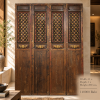
Some interior elements draw attention through elaborate ornament. Others become memorable because of the relationship between their structure, surface and surroundings. This Chinese antique screen brings these qualities together through geometric latticework, carved decorative bands and a weathered dark reddish-brown finish.
Dimension: Width 58 x Depth 6 x Height 274 cm.
Price: 114000 Baht
The Beauty of Imperfect Geometry
Some interior elements draw attention through elaborate ornament. Others become memorable because of the relationship between their structure, surface and surroundings. This Chinese antique screen brings these qualities together through geometric latticework, carved decorative bands and a weathered dark reddish-brown finish.
The three-panel composition has a clear architectural rhythm. Tall lattice openings occupy the upper sections, framed by dark timber and balanced by broad solid panels below. Carved ornamental bands create transitions between these areas, introducing flowing decorative details that contrast with the more disciplined lines of the lattice.
The surface adds another dimension. Variations in colour, visible grain and worn areas prevent the wood from appearing completely uniform. Rather than distracting from the pattern, these differences create a relationship between geometric repetition and surface individuality.
For an interior that values material character and thoughtful restraint, this combination offers a compelling alternative to perfectly coordinated decorative elements.
A Screen That Changes the Experience of Space
A screen can help organize a room without creating the visual finality of a solid wall. It provides a boundary, establishes a focal point and introduces a new layer to the composition of an interior.
This piece can help distinguish a living area from a dining space, create a backdrop behind a seating arrangement or define a particular zone within an open-plan residence. The geometric lattice adds visual complexity while retaining openings through which parts of the surrounding space remain visible.
The effect depends on placement. Positioned against a quiet wall, the screen can become the principal decorative feature. Used between adjoining areas, it can suggest separate functions while maintaining a visual connection between them.
This makes it relevant to contemporary homes where the arrangement of space matters as much as the selection of individual furnishings. Rather than treating a partition as a purely practical necessity, the screen allows spatial definition to become part of the interior design.
The Character of the Latticework
The geometric lattice is the most distinctive feature of the upper panels. Its irregular rectangular openings form a repeated pattern that is more intricate than a simple grid. The bars and intersections create multiple small shapes, producing a rhythm that draws the eye across the surface.
The surrounding frames establish a strong boundary around this pattern. Above the latticework, elongated inset panels provide a quieter visual element. Beneath it, carved ornamental bands introduce a more decorative language, with scrolling details and traces of gold-toned colour visible in the photograph.
The lower solid panels provide visual weight and balance. Their comparatively uninterrupted surfaces allow the latticework and carving to remain prominent without making the entire screen feel equally busy.
Together, these elements create a useful contrast between repetition and variation, ornament and restraint. The screen can therefore contribute to a room as a complete architectural composition rather than simply as a collection of decorative details.
A Weathered Finish That Adds Individuality
The dark reddish-brown finish gives the screen a warm, substantial appearance. Visible grain and variations in tone create differences across the panels, while worn areas reveal lighter colours beneath the darker surface.
These characteristics are particularly relevant to Wabi-Sabi interiors, where the visual relationship between materials, texture and imperfection can be more important than a uniformly polished appearance. The screen introduces a surface that rewards attention without requiring additional decoration.
Its weathered character should not be confused with a verified historical date or a particular origin. The appeal described here comes from the visible finish, latticework and carved details rather than an unsupported account of its past.
For collectors and homeowners, this is an opportunity to appreciate the object through its actual design. Its identity rests in the combination of form, material presence and surface character.
Styling the Screen in a Wabi-Sabi Interior
The strongest setting for this screen is one that allows its dark timber and intricate latticework to contrast with quieter materials.
Textured beige plaster, warm ivory walls and natural stone can establish a calm background. Simple furniture, neutral upholstery and a limited palette help maintain visual balance. A ceramic vessel or a restrained piece of artwork may complement the screen, but excessive ornament around it could compete with the details already present.
Natural side lighting can reveal the depth of the frames, the relief of the carved bands and variations in the wood. Soft shadows across the latticework also add depth to the overall composition.
In a Bangkok residence, this approach offers a way to introduce Chinese antique furniture into a contemporary home without recreating a wholly traditional interior. The objective is to create a thoughtful relationship between the screen and its surroundings, allowing both traditional design and modern simplicity to remain visible.
The same principles can apply to a villa, a carefully curated residence or a hospitality interior where a distinctive partition helps establish the atmosphere of a space.
Choosing the Right Placement
Before installation, consider how the screen will relate to circulation, furniture arrangement and the intended use of the room. It may serve primarily as a decorative backdrop or as a visual divider between adjoining areas.
If it is intended to function as a partition, assess stability, mounting requirements and the suitability of the installation. Confirm the practical arrangement on site rather than assuming that its appearance alone determines how it can be used.
A well-positioned screen should feel integrated into the room. Its purpose is not merely to occupy space, but to improve the relationship between the different areas, materials and visual elements around it.
An Individual Element for a Considered Home
The value of this screen within an interior lies in the combination of qualities it brings together: geometric structure, carved ornament, dark timber and a weathered finish. These elements provide visual interest while offering a practical way to distinguish areas within a room.
For homeowners, collectors and interior designers who appreciate Chinese antique furniture, it presents an opportunity to introduce traditional decorative design into a contemporary setting without relying on excessive ornament or a fully traditional scheme.
Explore the Chinese Antique & Reproduction Screens category at Chinese House to consider how a screen can contribute to room planning, material contrast and the character of a carefully curated interior.


 MakeWebEasy