
Refined Chinese Botanical Screen
Quantity
Short Description
As a Reproduction piece, it offers this visual language in a form intended for contemporary interiors. Its value lies in the combination of height, decorative complexity and practical spatial use—qualities that allow one substantial piece to influence the character of an entire room.
Dimension: Width 50 x Depth 5 x Height 232 cm.
Price: 49,000 Baht per set
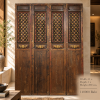
A screen can do more than divide a room. Used thoughtfully, it can give an interior a sense of proportion, establish a visual boundary and create a focal point without requiring a large architectural intervention. This four-panel Chinese Reproduction Screen is designed for precisely that role.
The first impression comes from its vertical form. At 232 cm high, the screen draws the eye upward and introduces a strong architectural presence into the room. Rather than functioning as a solid wall, the openwork sections allow light and visual depth to remain part of the composition. This makes the piece particularly suitable for contemporary living spaces where separation and openness need to coexist.
The surface combines several layers of decorative detail. The upper panels feature intricate openwork patterns surrounding a central circular motif, while the larger central sections incorporate carved relief panels. Botanical imagery continues through the lower sections, creating a visual rhythm across all four panels. Geometric corner details provide a more structured counterpoint to the organic forms of the flowers and foliage.
Its muted grey-brown wood finish gives the screen a restrained character. Rather than competing with surrounding furniture, it can sit comfortably within a palette of natural timber, stone, linen and neutral upholstery. In a contemporary luxury living room, it can work behind a sofa or console as an architectural backdrop. Positioned between connected areas, it can also establish a subtle transition between spaces without completely blocking the view.
The proportions are especially useful when working with tall walls or open-plan interiors. A vertically oriented screen can give an otherwise expansive room a stronger sense of scale, while its four-panel composition creates enough visual weight to anchor a seating arrangement.
This is where the distinction between decoration and interior structure becomes important. The screen is decorative in its carving and latticework, but its real contribution to a room is spatial. It can frame a view, define a zone, introduce contrast against contemporary furniture and give the interior a more considered relationship between traditional Chinese detailing and modern architectural surroundings.


 MakeWebEasy